
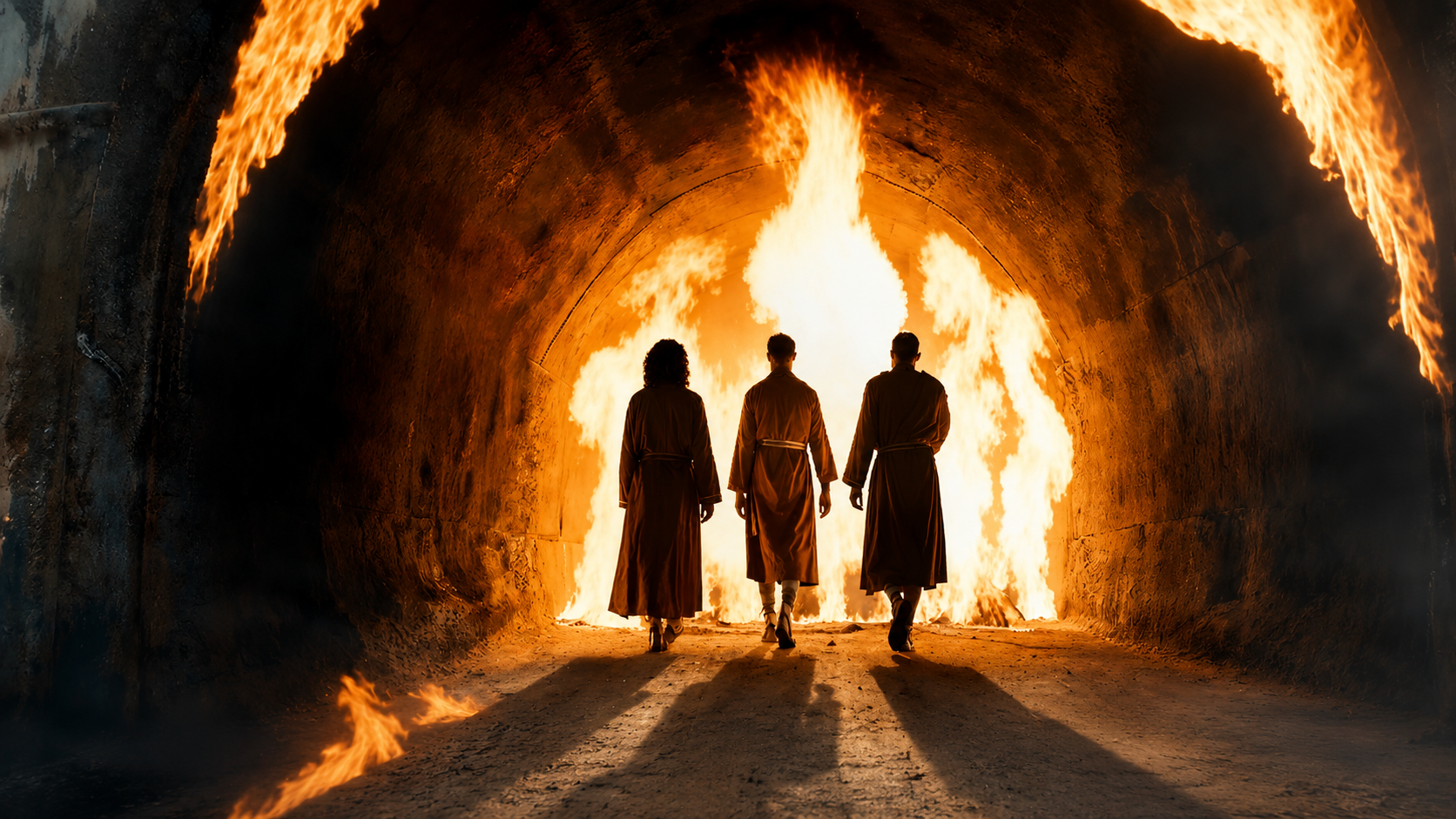
What Does Daniel Have to Do with the Fiery Furnace?
The short answer: Daniel didn’t go into the furnace. But his story and the story of his three friends are deeply connected—and together they paint a much bigger picture about faith under pressure.
You’re probably not the only person who has wondered about the title.
Daniel and the Fiery Furnace, the new biblical epic coming to theaters September 18, has everybody talking. And for good reason. The film brings one of the Bible’s most unforgettable stories to the big screen—and puts a fresh focus on the faith, courage, and convictions of the people at the heart of it.
But in the Bible, Daniel doesn’t go into the fiery furnace, right? In Daniel 3, it’s Shadrach, Meshach, and Abednego who refuse to bow to King Nebuchadnezzar’s golden image and are thrown into the flames.
So why call the movie Daniel and the Fiery Furnace?
Because the furnace is about much more than the three men who entered it.
Where It All Began
Daniel, Shadrach, Meshach, and Abednego were just young men when they were taken from their homeland and brought into Babylon. They were forced to live in a culture that didn’t share their faith—and yet they continued to hold onto who they were and what they believed.
As the film’s synopsis explains, “Exiled in ancient Babylon, the prophet Daniel rises to power under King Nebuchadnezzar as three faithful men defy the ruthless king, face the fiery furnace, and ignite a miracle that shakes the empire.”
And while the furnace may belong to three men, the question of what you do when following God comes with a cost belongs to all four.
Yes, Daniel’s friends are the ones who face the flames. But Daniel faces his own pressures in Babylon. That’s why this biblical epic isn’t simply about three men surviving a literal fire—but four men standing firm through a spiritual one.
A Different Kind of Fire
That tension is part of what makes the story particularly meaningful to Elijah Alexander, who plays King Nebuchadnezzar.
Alexander became a high school teacher during the pandemic and said the experience made him especially aware of the loneliness, isolation, sadness, and disillusionment many young people face today.
For him, the story of Daniel and his friends offers a different picture of what it means to live with conviction.
“The telling of this story, it affords an opportunity for [today’s] young people to say, ‘Hey, there’s another way of being in the world. Look at [Daniel and his friends]. Look at what they did. They were faced with the greatest challenge of all: life-and-death situations. What got them through it is their faith,’” Alexander noted.
“Young people have to be encouraged to feel their way into their faith, and then encouraged to be outspoken in it, to stand for something, to believe something,” he added. “Because faith without action is nothing.”
Not the Flames, But the Faith
The fiery furnace is one of the most unforgettable moments in the Book of Daniel because it puts faith under the most extreme pressure imaginable. And that is ultimately the key to the whole story.
Surviving the furnace wasn’t the start of the miracle – it was the conclusion. The miracle started with Daniel and his friends choosing to stand firm when their faith was tested.
Babylon changed their names. Changed their education. Changed their culture. Changed their environment. But it could not change their identity.
That’s the thread connecting Daniel to the furnace.
Not necessarily the flames.
The faith.
See the Story on the Big Screen
Tickets are now on sale for Daniel and the Fiery Furnace, in theaters September 18.
And if you’re not an EKKL member yet, there’s an added reason to join. New annual EKKL members can receive two free tickets to see Daniel and the Fiery Furnace!
Get your tickets, bring someone you love, and experience this powerful story of faith and courage on the big screen.



September 7, 2026 @ 4:59 pm
The point is understandable. But should we rather make a movie that is biblically correct than to manipulate the story just to fit your modern ideology?
The movie’s intention might be right as it has an explanatory implications but the way it portraits the authenticity of events is somehow twisted. Let the BIBLE SPEAK FOR ITSELF than MAKING MY OWN VERSION OF THE STORY.